Computational governance research
A question provoked by a book about the deep history of human societies, explored through a governance dataset covering 401 systems from deep prehistory to the present.
The question
In 2021, the anthropologist David Graeber and archaeologist David Wengrow published The Dawn of Everything: A New History of Humanity. It was widely read and debated. The argument was straightforward and contentious: for most of human history, people regularly and deliberately chose between radically different ways of organising themselves. Societies were not locked into fixed evolutionary stages. They experimented, argued, and walked away from hierarchies that did not suit them.
Freedom and political self-determination, Graeber and Wengrow argued, were not modern inventions. They were ancient human capacities that many of our ancestors exercised quite consciously. Çatalhöyük, a 9,000-year-old settlement in Anatolia, shows no evidence of rulers or hierarchy. The Icelandic Commonwealth ran itself for three centuries without a king or state. The Haudenosaunee (Iroquois) Confederacy is often cited in discussions of collective governance and its possible influence on Enlightenment and constitutional thought.
“The ultimate, hidden truth of the world is that it is something we make, and could just as easily make differently.”
Graeber & Wengrow, The Dawn of Everything (2021)The book's historical claims have been widely debated, but its central question is empirically fertile. It raises an immediate empirical question: if societies really did have this capacity for self-determination, can we measure whether they used it? Can we compare Athens in 450 BCE with the Tang Dynasty in 700 CE, or the Tokugawa Shogunate with modern Norway, and say something rigorous about how free people were to push back against power?
Graeber and Wengrow worked primarily with qualitative historical and archaeological evidence. The isonomia project asks what happens if you take their core ideas seriously and try to turn them into numbers.
Isonomia (ισονομια) is an ancient Greek term meaning equality before the law: the equal right of citizens to participate in governance and hold power accountable. The Athenians used it to describe the conditions that made democracy possible. It is older than the word demokratia itself, and captures something more fundamental than voting rights. It describes the practical freedom to refuse, resist, and replace those who govern you.
The framework
The first challenge was conceptual: what exactly do you measure? Political freedom is not a single thing. A society can have free elections but a secret police. It can permit public debate whilst making it physically impossible to leave. The Roman Republic held elections for centuries whilst progressively stripping those elections of any genuine power.
The isonomia framework decomposes political freedom into six dimensions, each coded on a scale from 0 to 1.
Sovereignty index. How much concentrated coercive power does the ruling apparatus hold? High S means hard to resist.
Administrative capacity. How deeply does the state penetrate daily life through census, taxation, education, and surveillance?
Political competition. How genuinely contested is access to power? Can outsiders realistically challenge incumbents?
Exit freedom. Can people leave or withdraw from the system without catastrophic cost?
Disobedience freedom. Can people refuse compliance, protest, or organise opposition without immediate severe punishment?
Replacement freedom. Can the governed actually remove and replace their rulers through legitimate means?
Of these six, D (disobedience freedom) is the central dimension for this project. It is the closest analogue to Graeber and Wengrow’s concept of societies that retained the practical capacity to say no.
Graeber and Wengrow were primarily interested in showing that alternatives existed and that early societies were not trapped in a linear evolutionary progression. The isonomia project takes their insight in three directions.
First, it asks not just whether societies had political freedom, but how much, and whether that quantity can be tracked across time. Second, it asks what happens when freedom is lost: what triggers the suppression of D, and can it be reversed? Third, it tests these questions against 2,600 years of evidence from 401 governance systems across every inhabited continent, cross-validated against six independent modern political-science datasets.
The framework does not assume that freedom follows a single historical arc. It assumes precisely the opposite: that political freedom is unstable, contested, and can be won or lost at any point in history, exactly as Graeber and Wengrow argued.
Interactive explorer
Plot any governance system’s sovereignty (S) against its disobedience freedom (D) and a pattern appears. Most systems do not scatter randomly. They cluster in ways that reflect a basic tension in governance: the more coercive power a ruling apparatus concentrates, the harder it tends to be for citizens to say no.
Every point below is a real governance system from the dataset. Hover or tap for its name and values. Use the filters to highlight by world region or to see specifically the systems Graeber and Wengrow discuss in The Dawn of Everything.
A note on reliability: Codings vary in quality from well-documented modern states to speculative prehistoric cases. The main statistical findings use only the better-documented subset. Full detail in the reliability section.
Dashed line at D = 0.45 marks the critical lock-in threshold identified in Paper 2. Points represent all 401 governance systems in the dataset.
The dashed line at D = 0.45 is not arbitrary. Statistical analysis of the full dataset identifies it as a critical transition: once a system’s disobedience freedom falls below this threshold, the probability of recovery drops sharply. Systems starting above the line have a 6.46× higher odds ratio for avoiding full lock-in (Paper 2). Below it, the structural conditions for organised resistance are substantially harder to maintain.
Interactive explorer
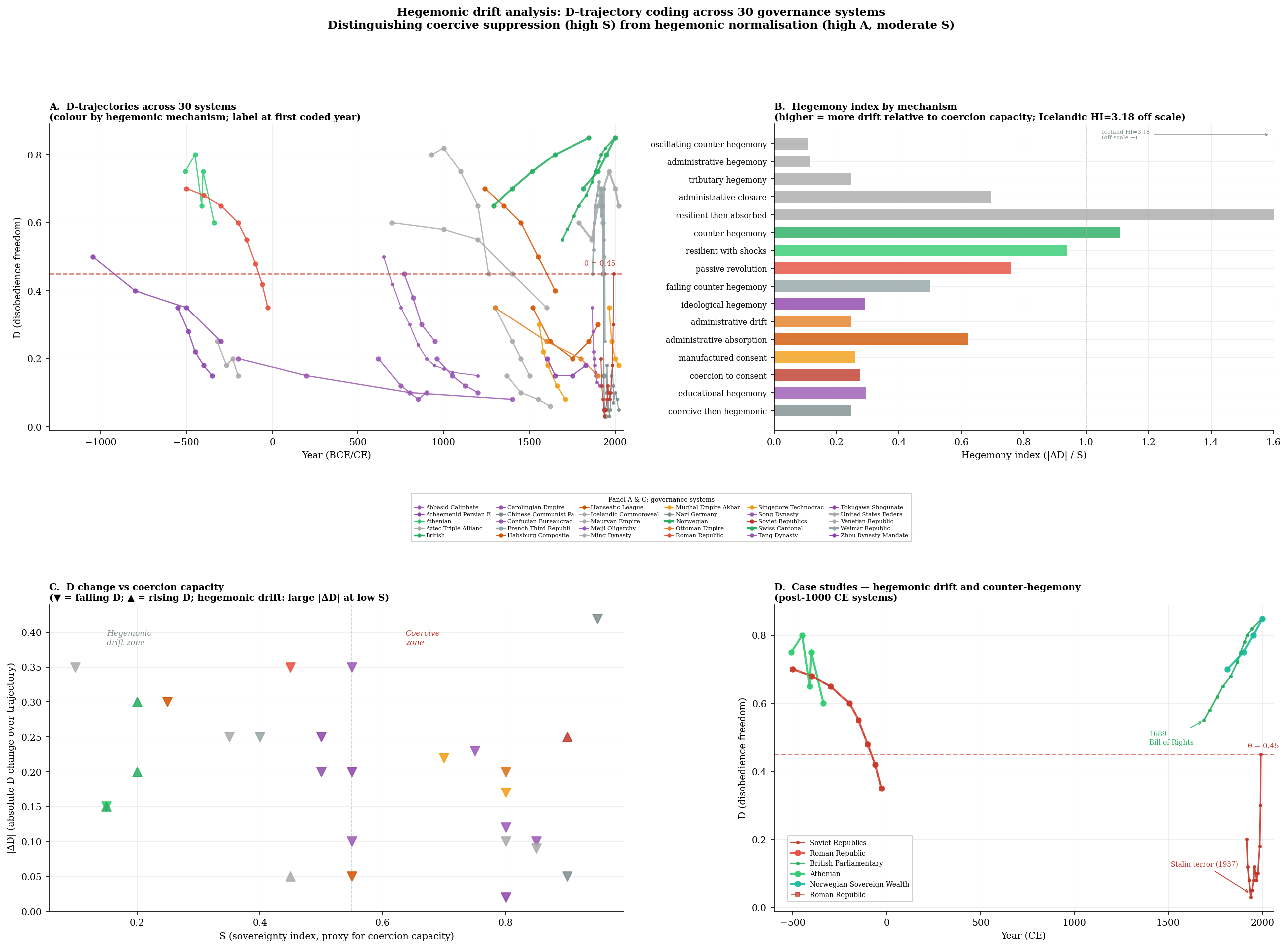
The full dataset codes 401 systems as cross-sectional cases. A smaller trajectory subset of 30 systems has enough temporal evidence to code D at multiple time points, ranging from four to fourteen observations per system. For these 30 systems, it is possible to track D not just as a snapshot but as a series of measurements across centuries. The result is a set of trajectories that show very different stories about how political freedom is won, lost, and occasionally recovered.
Select any system below to see its trajectory. The dashed line marks the critical threshold at D = 0.45.
Disobedience freedom (D) over time for the selected governance system
The trajectories show patterns that are impossible to see in a single-point measurement. The Roman Republic’s 473-year gradual decline from D = 0.70 to 0.35. The Soviet Union’s plunge to near zero under Stalin, partial recovery, and then rapid expansion during glasnost. The British Parliamentary System’s slow but consistent rise from 0.55 at the Glorious Revolution to 0.85 by the late twentieth century.
The full research figure, showing all 30 trajectories simultaneously, is below.
The mechanism
One of the more consistent findings is that the suppression of political freedom is not random. It follows a reproducible sequence that appears across systems separated by thousands of years and tens of thousands of kilometres.
Reading left to right: surplus resources (L) fund institutionalisation (I: the construction of durable offices, rules, records, and enforcement routines), which in turn expands administrative capacity (A). Once that apparatus is sufficiently developed, it begins to constrain the freedom to leave (E). As exit becomes harder, the freedom to disobey (D) follows, and finally the ability to replace rulers (R) is foreclosed.
This sequence maps onto the history of state formation across the ancient world. The Mauryan Empire, the Tang Dynasty, the Roman Republic’s transformation into the Principate, the Ottoman Empire under the Hamidian autocracy: all follow recognisable variants of this pattern.
The lock-in sequence is documented in Paper 2 (draft complete), which applies logistic regression and survival analysis to the full 401-system dataset. The sequence is derived empirically from transition probabilities between states, not imposed as a theoretical prior. The D⊂0; odds ratio (6.46) is from a logistic regression with D⊂0; as predictor and lock-in status as outcome. The 5.03× exit rate is from a Cox proportional hazards model. Both are reported with 95% confidence intervals in the paper.
S = sovereignty index (0–1): concentrated coercive power of the ruling apparatus.
A = administrative capacity (0–1): depth of state penetration through records, taxes, education, surveillance.
D = disobedience freedom (0–1): practical freedom to refuse compliance or organise opposition without severe sanction.
D₀ = the initial level of D at the start of a trajectory or lock-in process. A high D₀ gives citizens more structural room to resist before the window closes.
θ = the empirically estimated critical threshold, here D = 0.45. Systems that fall below this level show sharply lower probabilities of recovery. It is a statistical regularity in the data, not a theoretical assumption.
L = surplus resource legibility (surpluses that are identifiable and extractable by the state). I = institutionalisation. E = exit freedom. R = replacement freedom.
Not all systems lock in equally. The key variable is the initial level of disobedience freedom, D₀, at the point when the lock-in process begins. Systems starting above the θ = 0.45 threshold show a 5× higher exit rate from the lock-in pathway. They have more room to organise, protest, and resist before the window closes.
This matters practically. Political freedom is not just an outcome but a structural resource. Societies that begin with high D₀ are substantially harder to lock in. This is consistent with why authoritarian consolidations so often target civil society, press freedom, and the right to organise first: not because these things are immediately threatening, but because they represent the structural D₀ that makes resistance possible later.
Societies that begin with high disobedience freedom are substantially harder to lock in. High D₀ is the structural resource that makes later resistance possible.
A related finding from a separate model (a continuous-time Markov chain applied to succession mechanisms, Paper 3) shows what happens to leadership replacement as lock-in progresses. As administrative capacity rises and political competition falls, governance systems converge on an appointment attractor: a stable state in which power is transferred by the incumbent to a chosen successor. The equilibrium probability of this state reaches π = 0.595 in high-surplus systems.
This appears in Bronze Age palaces, mediaeval courts, twentieth-century single-party states, and contemporary hybrid regimes. The mechanism is structural, not cultural.
How suppression works
A further question: when D falls, how does it fall? Blunt coercion, through secret police, imprisonment, and physical violence, is one answer, but it is not the most durable one. The most enduring suppression of political freedom does not need continuous force. It works by making the idea of resistance culturally unavailable.
This is what the Italian theorist Antonio Gramsci called hegemony: the ruling class does not merely compel compliance, it manufactures consent. Subjects internalise the worldview of those who govern them so thoroughly that alternatives become literally inconceivable. Michel Foucault described a related mechanism in his analysis of disciplinary societies: when populations are organised under sufficiently comprehensive surveillance, they police themselves.
Paper 5 tested these ideas across 30 governance systems and found four empirically distinguishable mechanisms by which D declines or recovers.
D declines as educational institutions, legal systems, and cultural norms normalise compliance. The Abbasid Caliphate is the clearest case: freedom continued to erode for three centuries after the coercive capacity that established suppression had collapsed. The hegemonic apparatus had become self-reproducing.
D is kept low through the direct application of state force. These systems typically begin with low D₀ and stay there. Remove the coercive apparatus and suppression may lift, but it is expensive and fragile to maintain.
D rises through the deliberate construction of civic institutions (trade unions, free press, independent courts) that embed a culture of dissent across generations. All three rising-D systems in the dataset (Britain, Switzerland, Norway) have sovereignty indices at or below S = 0.20: the state must be weak enough not to crush these institutions whilst they are forming.
Both administrative capacity and disobedience freedom decline together under imperial overextension. The Ottoman Empire in its final century is the case study: as Tanzimat administrative modernisation failed and provincial control collapsed, the Hamidian autocracy intensified coercion to compensate.
One case is worth noting separately. The Tokugawa Shogunate in Japan (1603–1868) sits in the stable-low zone of the phase space: D remained suppressed throughout with minimal change, yet not through active coercive deployment. Instead it was produced by what Foucault would recognise as a panopticon. The mandatory residence system (sankin-kōtai), five-family mutual accountability groups (goningumi), temple registration, and hereditary status categories created a social architecture in which the state’s presence did not need to be felt because it could always, in principle, be felt. The Shogunate inherited a population that had lived through 150 years of civil war and actively wanted order. It began at its equilibrium rather than drifting to it.
How reliable is this?
The full exploratory dataset includes 401 systems from Palaeolithic band societies to contemporary states, ranging back to 300,000 BCE in the most speculative cases. The main statistical papers focus on the better-documented historical subset, spanning roughly 2,600 years. The quality of evidence varies enormously across this range, and it is worth being direct about where the codings are well-grounded and where they are speculative.
Each system is assigned a review class (1–3) reflecting the combination of evidence quality and interpretive difficulty. Level 3 does not mean most certain; it means the evidence is richest but the governance interpretation is most contested.
264 systems (66%) are early prehistoric cases with thin or indirect evidence. The core statistical findings in the papers are robust to excluding these systems; all primary analyses use the better-documented subset. Individual ancient codings should be treated with caution.
Separately from the review class, each system has an evidence strength rating (2–5) reflecting the richness of the source material.
72 systems have no evidence strength coding yet. All are flagged in the dataset.
The core metrics are compared against six independent datasets where overlap exists. Modern systems are validated against V-Dem, Polity5, WJP, Freedom House, and CCP. Pre-modern administrative and complexity indicators are compared against Seshat, making it relevant across a wider time range than the modern benchmarks.
| Dataset | Correlation |
|---|---|
| Freedom in the World (FIW) | r = 0.923 |
| WJP Rule of Law Index | r = 0.904 |
| V-Dem | r = 0.868–0.912 |
| Polity5 | r = 0.847 |
| Seshat | r = 0.604–0.774 |
| CCP | r = 0.681 |
Validation applies to the modern subset only. Ancient and medieval codings cannot be validated against these benchmarks.
The main limitations to hold in mind when reading the findings:
The dataset includes 112 systems starting before the Common Era, of which a portion extend back to the Palaeolithic (pre-10,000 BCE). These codings are necessarily more speculative than the medieval or modern cases. They are based on archaeological evidence for settlement patterns, storage structures, burial differentiation, and monument construction, interpreted using anthropological models of band and chiefdom governance.
The primary statistical findings (lock-in sequence, D₀ odds ratio, hegemonic drift mechanism tests) are all derived from systems with at least moderate confidence ratings and are robust to the exclusion of the Palaeolithic subset. That subset is included in the dataset for completeness and because even speculative comparative data has value, but readers should treat individual ancient codings with appropriate scepticism.
Some of the most historically contested systems in the dataset (the Roman Republic, the Iroquois Confederacy, Çatalhöyük, the Aztec Triple Alliance) are assigned coding confidence level 3, which in this scheme means not “most certain” but “most contentious to code.” These are systems where the documentary or archaeological record is rich but where historians actively disagree about interpretation. The codings represent a defensible reading of the evidence, documented in the notes field of the dataset, but alternative reasonable readings exist and are acknowledged.
The full coding notes are available in governance_extended.csv in the repository.
The research
Each paper addresses a distinct question using the same underlying dataset and framework.
Establishes the governance coding scheme, validates it against six external datasets, and maps 401 governance systems in six-dimensional phase space. The foundational paper for the series.
Journal of World-Systems Research (submitted May 2026)
Documents the L→I→A→E↓→D↓→R↓ sequence and establishes D₀ as the key moderator. Odds ratio of 6.46 for avoiding lock-in in high-D₀ systems, with a 5× higher exit rate.
Target journal: TBC
Applies continuous-time Markov chain modelling to leadership succession mechanisms. Documents the appointment attractor (π = 0.595) and the consensus founding-state finding.
Target journal: TBC
Agent-based model of Bateson’s schismogenesis concept applied to governance networks. Reproduces the degree-4 sign reversal and confirms three Graeber-Wengrow case studies.
Target journal: TBC
Integrates the findings of Papers 1–4 into a unified synthesis, submitted as a standalone contribution to the cliodynamics literature, with six embedded figures.
Cliodynamics (submitted 2026)
Disaggregates D-suppression into four mechanisms. Proposes the sign of r(ΔA,ΔD) as a non-circular mechanism classifier. 30 systems, 2,600 years of trajectory data.
Social Evolution & History (submitted June 2026)
Results
These are the findings that have survived statistical testing most consistently across the papers to date.
Higher odds of avoiding lock-in for systems starting above D = 0.45 (logistic regression, Paper 2).
Hegemonic systems begin with significantly higher D than coercive systems (Mann-Whitney, Paper 5).
Pooled correlation between administrative capacity expansion and D decline across 79 historical intervals in 9 systems (Paper 5).
Equilibrium probability of appointment-based succession in high-surplus systems: the appointment attractor (CTMC, Paper 3).
Sovereignty threshold below which counter-hegemonic D recovery appears possible. All three rising-D systems fall below this (Fisher exact p = 0.030, Paper 5).
Duration for which Abbasid hegemonic suppression of D persisted after the coercive capacity that established it had fully collapsed (Paper 5).
The lock-in sequence has been observed in enough modern governance systems to suggest that the structural mechanisms identified here are not exclusively historical. The D₀ result is particularly relevant: the evidence suggests that the most effective protection against autocratic consolidation is the prior existence of a high-D political culture, with the civic institutions, legal traditions, and cultures of organised dissent that sustain it. Dismantling those institutions, even incrementally, reduces the structural resource available for resistance later.
The hegemonic inertia finding suggests that removing a coercive apparatus may be insufficient to restore freedom in societies where the normalisation of compliance has become deeply embedded. The Abbasid case shows that even after coercive capacity is gone, D may continue falling for centuries because the educational, juridical, and cultural infrastructure of compliance has become self-reproducing.
How it developed
Starting point
The Dawn of Everything proposes that human societies have always had the capacity for radical political self-determination. The isonomia project asks whether this can be formalised and tested.
Foundation
401 governance systems coded across six dimensions. Cross-validated against V-Dem, Polity5, WJP, Freedom in the World, CCP, and Seshat.
Core finding
The L→I→A→E↓→D↓→R↓ sequence documented. D₀ identified as the key moderator. The θ = 0.45 critical threshold established. Appointment attractor modelled via CTMC (Paper 3).
Deepening
Bateson’s schismogenesis applied to governance networks via agent-based modelling. Three Graeber-Wengrow case studies confirmed computationally (Paper 4).
Refinement
Not just whether D falls, but how. Four pathways identified. The Gramsci-Foucault-Bateson synthesis operationalised. The r(ΔA,ΔD) sign classifier proposed (Paper 5).
June 2026
Hegemonic drift analysis across 30 systems submitted to Social Evolution & History.
Open research
All data, analysis scripts, and coding documentation are publicly available. Every statistical result in the papers can be reproduced from the source data using the provided scripts.
The repository contains: